
Goals for Driver Education

As Dr Elizabeth Box stated last year on an episode of Terry Cook's Instructor Podcast, the fact that the Goals for Driver Education have been around for well over 20 years now is proof of their relevance and importance to road safety.
It is as important today as it was back then that all driving instructors have at least a passing acquaintance with the concept behind the fabled "GDE Matrix". If you're new to the GDE, here's a quick explainer.
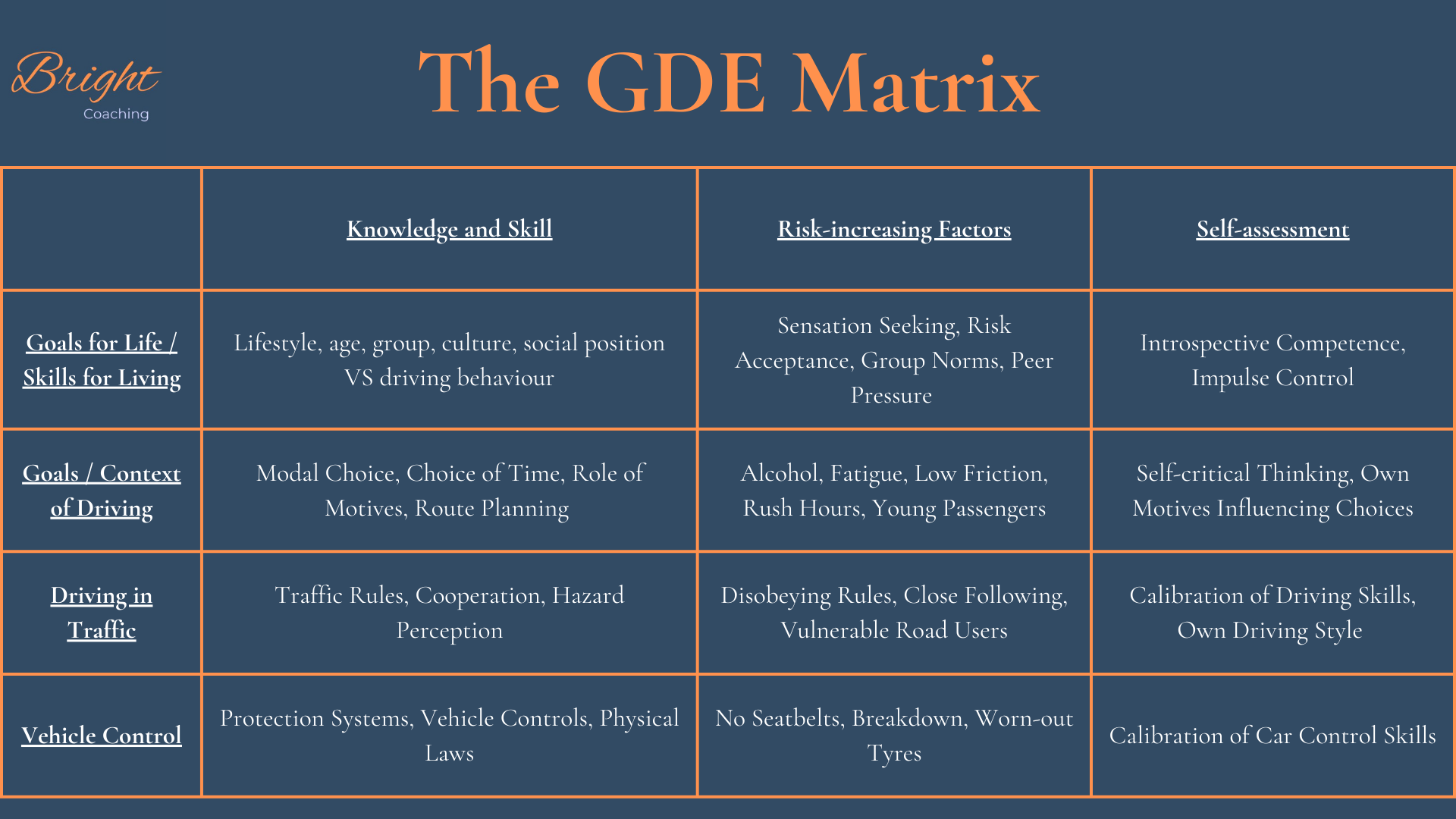
The matrix represents an "ideal" set of skills, knowledge, and understanding that would exist in a perfect driver education programme.
All the concepts contained within it are the "Goals" of a perfect "Driver Education" programme - the GDE.
The "Matrix" is just the grid on which the "Goals" are presented, and it has four levels (in its simplest version) and three columns.
The lower two levels and first two columns (reading left to right) represent what a learner driver has to know, understand, and demonstrate to pass a UK driving test.
However, it is the upper two levels and the third column that address influences, behaviour, and reflection. It is the factors contained here that cause road crashes - not the levels required for test.
This situation is obviously problematic. It means that a young person must demonstrate to the government that they are technically proficient, but not that they are mentally equipped for the real-life pressures of driving.
Until we have a system of assessing new drivers at the higher levels of the GDE - spoiler alert, this will never happen - it is the responsibility of the rest of us to help our learners think about the higher levels before they pass their tests and head out on the roads, driving for work, or in a car full of their friends on rural roads in the middle of the night.
The good news is that this is straightforward to do, by expanding our Q&A techniques to address values and our learners' sense of identity.
When your learner makes a mistake (can we all stop with the word "fault", please?), we are generally pretty good at examining what went wrong. Whatever method you use to help your learners with mistakes, generally we check that they remember the correct way to do the thing, we check that they understand why that's the correct way, we might ask about the potential consequences of the mistake, and we ask if they'd like any help on the next attempt.
This is all well and good and would satisfy any examiner on a Standards Check.
To go further (higher on the GDE) at the end of the lesson, ask your learner to reflect on the mistake that happened earlier. Specifically, ask them to think about what would potentially have caused them to make that mistake after they've passed their test.
Society has the wrong idea about what a driving test proves. The flawed idea is that a test pass equates to a driver who does not make mistakes. It's so ridiculous that typing that made me cringe. Everyone makes mistakes. This is what being human is.
By asking your learner to think about what would have to be happening for them to make that mistake in the future, you are inviting them to think about the higher levels of the GDE.
The Goals for Driver Education allow us to normalise human factors and raise awareness of a young – or any! - driver’s susceptibility to error. That, more than any test pass, is what will keep our learners safe once they're out there on their own.
Stewart Lochrie.
